Introduction
Practicing good medicine is only part of building a successful clinic now. If you’re having trouble getting new clients, seeing other clinics show up ahead of you in Google, or just feeling lost with online marketing, you’re not alone. Most vets I know want to show up online but aren’t sure what to do first. We have also added a case study for you to get motivation.
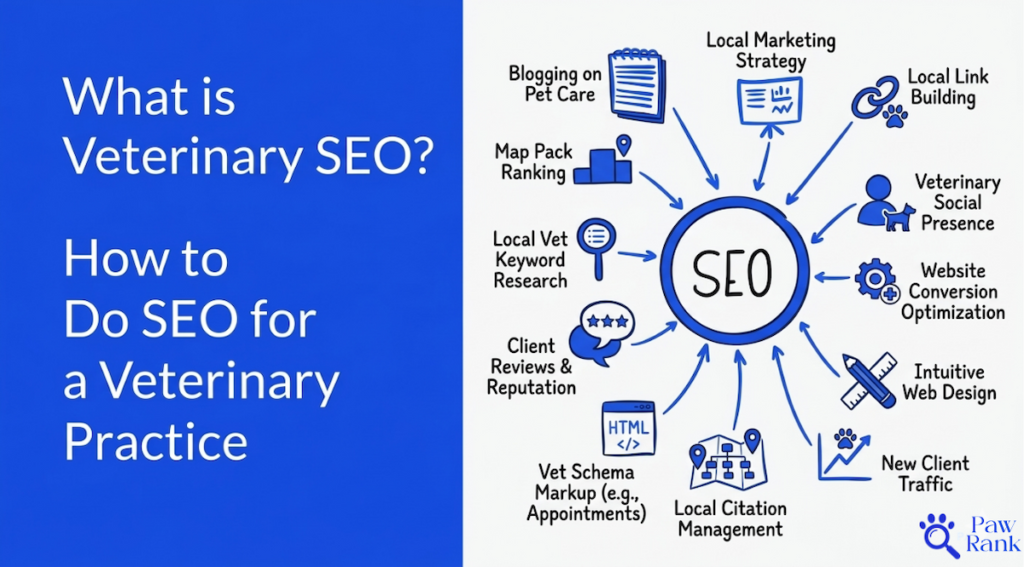
At Paw Rank, we’ve looked at hundreds of veterinary websites over the years. The same thing keeps happening: skilled teams get outranked by competitors because of a few small digital missteps. This guide breaks down the practical steps that actually work to help your clinic get found online.
1. Understanding Veterinary SEO: Your Digital Front Door
1.1 What is Veterinary SEO?
Veterinary SEO means making your website, Google Business Profile, and social media easier to find in search results. The goal is simple: help local pet owners find your clinic when they need a vet.
Good SEO helps you show up in local searches, attract people who actually need a vet, and build trust before they call. When you get this right, you’ll rely less on paid ads and see more steady, organic traffic. This isn’t just tech work. It’s a practical way to grow your practice and help more pets.
| Concept | Definition | Key Goal | Why it’s Essential |
| Veterinary SEO | The specialized application of Search Engine Optimization strategies tailored to veterinary clinics and animal hospitals. It involves optimizing a clinic’s online assets to rank higher in search results for pet-related queries. | To increase organic online visibility, attract new clients, retain existing ones, and build a strong, trustworthy brand authority within the local community for veterinary services. | In an increasingly digital world, pet owners overwhelmingly use search engines (especially Google) to find local vets, research pet health issues, and read reviews. Without effective SEO, a clinic remains invisible to this crucial audience, losing potential clients to competitors and struggling to grow its patient base. |
| Online Presence | Encompasses a clinic’s website, Google Business Profile, social media profiles, and any other digital platforms where its information appears. | Ensure consistent, accurate, and appealing representation of the clinic across all online touchpoints. | A cohesive and positive online presence reinforces credibility and professionalism. Inaccurate or inconsistent information across platforms can confuse potential clients and negatively impact search rankings. |
| Organic Search | Unpaid listings that appear in search engine results based on relevance and authority, as determined by search engine algorithms. | To drive targeted traffic to the clinic’s website and Google Business Profile without incurring direct advertising costs per click. | Organic traffic is often considered more trustworthy and sustainable than paid advertising. High organic rankings position the clinic as a leading authority in its field, fostering long-term client relationships. |
1.2 Why SEO is Crucial for Veterinary Practices (More Than Just “Being Online”)
Most pet owners now use Google to find a vet. Over 90% of people use search engines to find local businesses, including veterinary clinics. (60 SEO Statistics You Should Read, 2023) When a dog starts limping, or a cat won’t eat, people grab their phone and search. No one is using the phone book anymore.
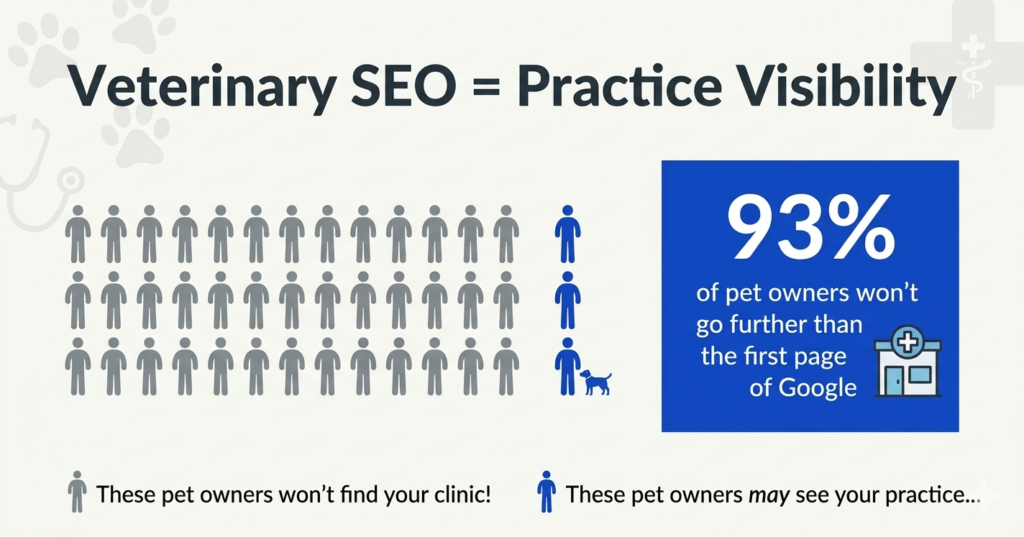
Showing up at the top of Google builds trust. Data shows that almost 93% of the searchers don’t go to next pages and select the business from the first page. Most people assume the clinics they see first are the best. If your clinic is near the top, you’ll get more calls and appointments. Simple as that.
Local search is competitive, especially for ‘near me’ searches. When someone types ’emergency vet near me’ or ‘dog vaccination near me,’ they’re ready to book. Your Google Business Profile is your most important local SEO tool. Keep it complete, accurate, and updated with new posts and photos. This is how you reach people who need a vet right now.
| Benefit | Impact on Practice | How SEO Helps |
| Increased Appointments | Direct growth in patient numbers and revenue. | By ranking highly for relevant service and “near me” keywords (e.g., “puppy vaccines [city]”, “emergency vet near me”), SEO ensures the clinic appears when pet owners are actively seeking services, driving direct traffic to booking pages or phone calls. |
| Enhanced Local Presence | Dominates local search results, becoming the go-to clinic in the community. | Optimizing Google Business Profile (GBP), building local citations, and acquiring location-specific backlinks make the clinic highly visible in Google Maps and local pack results, ensuring it’s the first choice for pet owners searching for local veterinary care. |
| Improved Online Reputation | Builds trust and credibility, attracting clients who value transparency and quality feedback. | SEO strategies include encouraging positive client reviews and professional responses to all feedback. A strong, positive review profile on Google and other platforms significantly influences new client decisions, as pet owners trust peer recommendations. |
| Sustainable Client Acquisition | Reduces reliance on expensive, short-term advertising campaigns. | Organic SEO efforts create long-term assets like high-ranking content and strong domain authority. Once established, these assets continuously attract qualified leads at a much lower cost per acquisition than paid ads, providing a more stable and predictable client flow. |
| Authority and Trust | Positions the clinic as a leading expert in pet health, fostering client loyalty and community respect. | Creating valuable, informative content (e.g., blog posts on preventative care, common ailments) that answers pet owners’ questions establishes the clinic as a trusted resource. This not only attracts clients seeking information but also builds a deeper relationship with existing clients, enhancing retention and word-of-mouth referrals. |
| Competitive Edge | Outperforms larger, more established clinics and online providers in local search. | Many veterinary practices overlook comprehensive SEO. By implementing a robust SEO strategy, even smaller clinics can gain a significant advantage in local search rankings, capturing market share that might otherwise go to less optimized but larger competitors. This levels the playing field and allows quality care to shine through online. |
Good veterinary SEO does more than improve your rankings. It brings in more appointments, builds your reputation, and connects you with your local community. Most clinics I’ve worked with see better results from SEO than from old-school ads. You become the clinic people trust for answers.
For a detailed breakdown of specific tactics that drive these results, see our guide on Veterinary SEO Strategies: The Only Guide You’ll Need. While this current guide gives you a complete, practical roadmap to get started and succeed with veterinary SEO, the linked resource provides more in-depth strategies for advanced results. You can achieve real progress with just this guide, but turn to the additional resource if you want to dive even deeper or tackle particularly competitive situations.
Real Results for Real Practices: The Sajjad Pets Clinic Story
It’s easy to talk about these five SEO pillars, but here’s what happens when you actually put them to work in a real clinic.
The Challenge: Sajjad Pets Clinic offered exceptional care but struggled with low online visibility. Despite a functional website, they were buried in local search results and missing out on predictable new patient flow in a highly competitive city.
The PAW Rank Solution: We implemented a targeted local SEO strategy—optimizing their Google Business Profile, launching hyper-local keyword campaigns, and executing a content series addressing common pet health questions in their exact area.
The result: In one month, they saw a 56% increase in new patient calls, moved up to 4th place in local search, and got more reviews.
2. The Pillars of Veterinary SEO: Your Holistic Strategy
SEO works when you get the basics right. Each part supports your online presence. If you skip one, you’ll notice.
Overview of Key SEO Components
| SEO Pillar | Brief Overview | Key Focus for Vets |
| Local SEO | Optimizing your online presence to attract customers in your specific geographic area, especially for “near me” searches. | Google Business Profile (GBP) optimization: Claiming, verifying, and fully optimizing your GBP listing with accurate information, photos, posts, and services.Local Citations: Ensuring consistent Name, Address, Phone (NAP) across online directories.Local Reviews: Actively encouraging and responding to client reviews on GBP and other platforms.Geographic Keywords: Targeting keywords like “vet [city]”, “emergency vet near me”. |
| On-Page SEO | Optimizing individual web pages to rank higher and earn more relevant traffic in search engines. | Service Page Optimization: Creating dedicated, keyword-rich pages for specific services (e.g., “Puppy Vaccinations [City]”, “Pet Dental Care [City]”).Header Tags: Using H1, H2, H3 to structure content with relevant keywords.Title Tags & Meta Descriptions: Crafting compelling, keyword-rich snippets for search results.Image Optimization: Using descriptive alt-text for clinic photos and pet images.Internal Linking: Connecting related service pages and blog posts. |
| Content SEO | Creating high-quality, valuable, and relevant content that attracts, engages, and informs your target audience. | Clinic Blog: Developing a blog with evergreen content that answers common pet owner questions (e.g., “What to do if your dog eats chocolate?”, “Seasonal pet health tips”).Service-Specific Content: Providing detailed, informative descriptions for each service page.Preventative Care Guides: Creating resources on topics like vaccinations, parasite control, and nutrition, establishing the clinic as an authority. |
| Technical SEO | Optimizing the technical aspects of your website to help search engine crawlers find, crawl, and index your site more effectively. | Website Speed: Ensuring fast loading times, especially on mobile devices.Mobile-Friendliness: Having a responsive design that works seamlessly on smartphones and tablets.HTTPS Security: Implementing an SSL certificate for a secure connection.XML Sitemaps: Submitting sitemaps to Google Search Console to aid crawling.Crawlability & Indexability: Ensuring search engines can access and list all important pages. |
| Reputation Management | Monitoring, influencing, and enhancing your clinic’s public perception and online image. | Online Review Strategy: Proactively asking satisfied clients for reviews on Google and other platforms.Professional Responses: Responding to all reviews (positive and negative) in a timely and professional manner.Social Listening: Monitoring mentions of your clinic across social media and review sites to address feedback promptly and maintain a positive brand image. |
Each pillar shows your expertise and builds trust. When you focus on these basics and use real examples from your clinic, you’ll attract more pet owners and turn them into loyal clients.
To understand how Google evaluates these signals when ranking your clinic, explore our in-depth analysis: How Google Ranks Veterinary Websites: Core Algorithm Signals.
3. Local SEO for Vets: Showing Up in ‘Near Me’ Searches
Local SEO is where most clinics win or lose. Most clients want a vet close to home. Here’s how to make sure they find you when they search.
You Need an Audit Before Everything:
Before you change anything on your Google Business Profile or write new content, you need to know what’s broken. Optimizing a site without this is like doing surgery without an x-ray.
You need a clear picture of:
- Where your website currently ranks for key terms (e.g., “vet in [city]”)
- Hidden technical errors slowing your site down
- Inconsistencies in your local directory listings across the web
Stop guessing with your SEO.
Get your free SEO Audit Now →3.1 Google Business Profile (GBP) Optimization: Your #1 Local Asset
If you’re not sure where to start with SEO, begin with your Google Business Profile. Most clients see this first when they search for a vet, and it often decides whether they call you or someone else.
| GBP Section | Optimization Action | Importance |
| Claim & Verify | Ensure your clinic’s Google Business Profile is claimed and verified through Google’s process (e.g., postcard, phone, email). This establishes ownership and allows full management of the listing. | Claiming and verifying is your first critical step. Without verification, you cannot fully control your listing, respond to reviews, or access insights. This is non-negotiable. |
| Business Name | Ensure the name stated on your GBP listing exactly matches your official clinic name. Avoid adding extra keywords or taglines that are not part of your legal business name. | Consistency is a major trust signal for Google. Inconsistent naming across platforms can confuse the algorithm and hurt your rankings. |
| Address | Ensure your physical street address is accurately entered and consistent across all online platforms. Use the precise address format recognized by postal services. | Your address must be exact. Even small variations (Suite vs. Ste., Street vs. St.) can create citation inconsistencies that dilute your local SEO strength. |
| Phone Number | Provide the primary contact number for your clinic. Ensure it’s active, correctly formatted, and easily clickable on mobile devices. | A local phone number builds trust. Make sure it matches the number on your website and other directories. Mobile users should be able to tap to call instantly. |
| Website URL | Add your clinic’s official website address. Ensure it’s correct and links to the live site. | This drives traffic from your GBP to your website where you can provide more detailed information and convert visitors into clients. |
| Hours of Operation | Keep your clinic’s business hours, including special holiday hours or temporary closures, perfectly up-to-date. Google uses this for “open now” searches. | Nothing frustrates pet owners more than arriving at a closed clinic. Accurate hours prevent negative first impressions and wasted trips. Update immediately when hours change. |
| Services Offered | List all the veterinary services your clinic provides, from routine check-ups and vaccinations to specialized surgeries and emergency care. Use specific keywords where possible (e.g., “dog teeth cleaning,” “cat spay”). | Service listings help you appear in more specific searches. Someone searching “dog dental cleaning near me” is more likely to find you if you’ve listed this specific service. |
| Categories | Select the most precise categories that describe your veterinary practice (e.g., “Veterinarian”, “Animal Hospital”, “Pet Boarding Service” if applicable). Be specific but avoid over-stuffing. | Categories are primary ranking factors. Choose your main category carefully—“Veterinarian” or “Animal Hospital” should be primary, with additional relevant categories as secondary. |
| Photos & Videos | Upload high-quality, professional images of your clinic’s exterior, interior, waiting room, exam rooms, team members, and happy, healthy pets. Include a virtual tour if possible. | Visual content builds trust and emotional connection. Listings with photos receive 42% more requests for directions and 35% more click-throughs to websites than those without. |
| Description | Craft a clear, engaging, and keyword-rich “from the business” description (up to 750 characters). Highlight your unique selling propositions, clinic values, and main services. | This is your elevator pitch. Use natural language that includes your location and primary services. Don’t keyword stuff—write for humans first, search engines second. |
| Posts | Regularly publish updates to your GBP. This can include announcements, offers, events, or product updates. Use high-quality images and clear calls-to-action. | GBP posts keep your listing active and fresh. They signal to Google that you’re an engaged business. Post 2-3 times per week with clinic news, pet health tips, seasonal promotions, or new services. |
| Q&A Section | Actively monitor and answer questions asked by users in the Q&A section. You can also proactively add frequently asked questions and their answers. | The Q&A section is often overlooked but visible to all potential clients. Proactively add FAQs like “Do you accept walk-ins?” or “What payment methods do you accept?” to control the narrative. |
| Review Management | Actively solicit positive reviews from satisfied clients on Google and other relevant platforms. Respond promptly and professionally to all reviews, both positive and negative, to demonstrate client care and transparency. | Reviews are critical social proof. Actively encourage happy clients to leave reviews, and respond to every single one—positive reviews with gratitude, negative reviews with empathy and a solution. |
Key Notes for GBP Success:
- Always maintain consistency of NAP (Name, Address, Phone) data across all online platforms.
- Regularly update your GBP with new photos, videos, and posts to keep it fresh and engaging.
- Ensure your chosen categories accurately reflect your primary services.
- Respond to all reviews promptly and professionally—this shows potential clients that you care.
Quick win: Add a Google Map to your Contact page.
Go to Google Maps, search your clinic, click Share, select Embed a map, and paste the iframe code into your Contact page. This does two things. It gives pet owners one-tap directions without leaving your site. And it gives Google a clear, confirmed signal tying your website to your physical location. Takes ten minutes and pays off in local ranking strength.
Optimizing your Google Business Profile is the single most important local SEO step. It decides where you show up in Google Maps and local results. A complete, active profile builds trust and makes it easy for pet owners to call, visit your website, or get directions.
Add a local map to your contact page. This makes it easy for both Google and pet owners to see where you are and get directions.
3.2 Local Citations & Consistency: Building Authority Beyond Google
Local citations are mentions of your clinic’s name, address, and phone number on sites like Yelp, Yellow Pages, Healthgrades, and local business directories. Each citation is a vote of confidence in your clinic’s legitimacy and location. (Local Citations | SEO Glossary Term Definition, 2026)
Consistency is key. When Google sees the same name, address, and phone number everywhere, it trusts your clinic is real and established. If your address is listed as ‘123 Main St.’ in one place and ‘123 Main Street’ in another, Google may not connect them, and that can hurt your local rankings. (Newton, 2025)
For clients, citation consistency means they always find the right contact details. Nothing erodes trust faster than calling a disconnected number or showing up at the wrong address because of outdated information.
Key Citation Sources for Veterinary Clinics:
- General business directories (Yelp, Yellow Pages, Bing Places, Apple Maps)
- Industry-specific directories (AVMA, VIN, local veterinary associations)
- Chambers of Commerce and local business groups
- Healthcare directories (Healthgrades, Vitals, Zocdoc)
- Local community websites and blogs
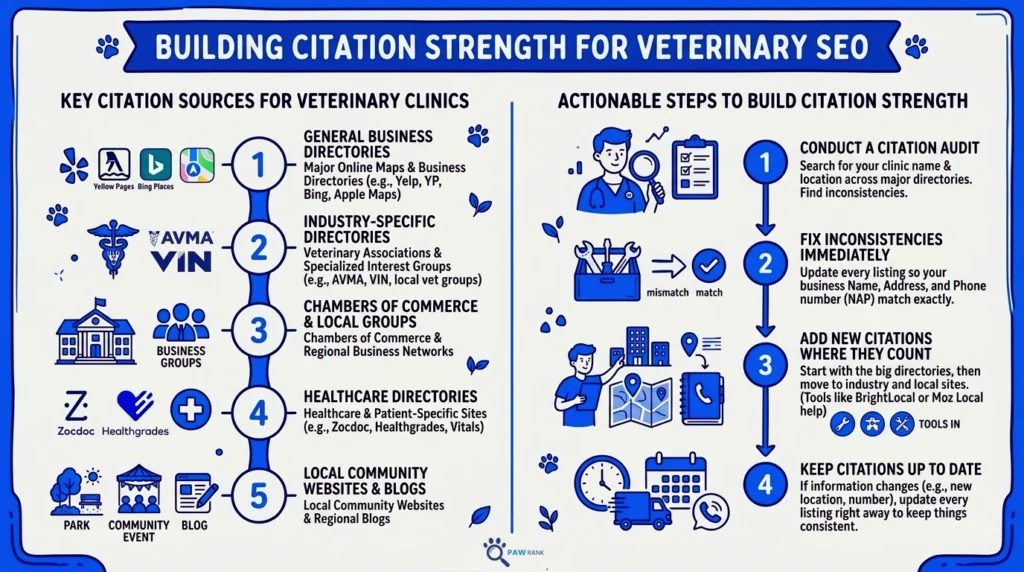
Actionable Steps to Build Citation Strength:
- First, conduct a citation audit. Search for your clinic name and location across major directories. Note any inconsistencies in NAP information, missing listings, or outdated details.
- Next, fix any inconsistencies right away. Update every listing so your business name, address, and phone number match exactly. It’s tedious but important.
- Next, fix any inconsistencies right away. Update every listing so your business name, address, and phone number match exactly. It’s tedious but important.
- Then, add new citations where they count. Start with the big directories, then move to industry and local sites. Tools like BrightLocal or Moz Local can help you find gaps and keep track.
Keep your citations up to date. If your clinic changes location, phone number, or name, update every listing right away to keep things consistent.
4. Keyword Research for Veterinary Clinics: Finding Your Audience’s Questions
Effective SEO starts with understanding how pet owners search for a vet. Keyword research isn’t about gaming the system. It’s about matching your content to the real questions and needs of your clients.
4.1 Understanding How Pet Owners Search
Pet owners search in four primary ways, each representing a different stage in their journey:
Informational Searches: These are research questions, like ‘What to do if my dog is limping?’ or ‘Signs of cat diabetes.’ These people may not need a vet today, but they’re potential future clients.
Navigational Searches: These happen when someone is looking for your clinic by name, like ‘Happy Tails Veterinary Clinic address’ or ‘Dr. Smith veterinarian hours.’ These are usually existing clients or referrals.
Transactional Searches: These show high intent, like ‘Puppy vaccines cost [city]’ or ‘book dog grooming appointment.’ These people are ready to become clients. They just need to find the right clinic.
Local Searches: These combine service and location, like ‘Emergency vet near me’ or ‘best animal hospital in [neighborhood].’ These are your highest-value searches because they show both need and proximity.
To show up for ‘near me’ searches, use phrases like ‘vet near me’ or ’emergency vet [your city]’ in your content where it fits. Voice search is growing, too. People ask their phones things like ‘Find a vet open now near me.’ Write your content to answer these questions in a natural, conversational way.
4.2 Identifying Relevant Keywords for Your Practice
| Keyword Type | Description | Examples | Strategic Application |
| Service-Based Keywords | Keywords tailored to specific treatments or procedures your clinic offers. | “dog dental cleaning [city]”“cat spay procedure [city]”“exotic pet vet [city]”“pet surgery services [city]” | Create dedicated service pages for each major offering. Use these keywords in your page titles, headers, and throughout the content. These keywords attract clients who know what service they need. |
| Location-Based Keywords | Keywords combining your services with your geographic area. | “best vet in [neighborhood]”“animal hospital [city name]”“[city] emergency veterinary clinic”“veterinarian near [landmark]” | Essential for local SEO. Include your city, neighborhood, and nearby landmarks naturally in your content. These help you dominate local search results where competition is most intense. |
| Problem-Based Keywords | Keywords addressing specific pet owner concerns or symptoms they observe. | “dog vomiting treatment”“limping cat care”“puppy lethargy causes”“pet skin rash symptoms” | Perfect for blog content. Create helpful articles that address these concerns, then link to your relevant service pages. These keywords capture pet owners in distress who need immediate help. |
| Long-Tail Keywords | More specific phrases with lower search volume but higher intent and less competition. | “cost of microchipping a dog in [city]”“symptoms of feline diabetes in older cats”“how to prepare puppy for first vet visit”“emergency vet open 24 hours [city]” | These are gold for smaller clinics. While they have lower search volume, they attract highly qualified traffic. Someone searching “emergency vet open 24 hours [city]” is ready to drive to your clinic right now. |
When conducting keyword research, use tools like Google Keyword Planner or the free version of SEMrush to identify relevant search terms for veterinary services. Look at:
- Search volume (how many people search this monthly)
- Competition level (how difficult it is to rank)
- Search intent (what the person is trying to accomplish)
- Commercial value (how likely they are to become a client)
Focus on keywords that match real pet owner questions. This shows you understand their needs and helps you rank higher.
5. On-Page SEO Best Practices for Vet Websites
Optimizing individual pages on your website tells search engines exactly what your content is about and why it deserves to rank. On-page SEO is where your keyword research meets your actual content creation.
5.1 Structuring Your Website for SEO
Website Slug/URL:
Your website structure should be intuitive for both users and search engines. Clean, descriptive, keyword-rich URLs make your site architecture clear. For example, use yourclinic.com/services/dog-vaccinations instead of yourclinic.com/page?id=123. The first URL immediately tells both users and search engines what the page contains.
Interlinking:
Internal linking is a strategic pathway creation. Link related service pages and blog posts together to help search engines understand relationships between your content and to keep visitors engaged on your site longer. A blog post about puppy care should link to your puppy vaccination service page. Your dental cleaning service page should link to your blog post about preventing pet dental disease.
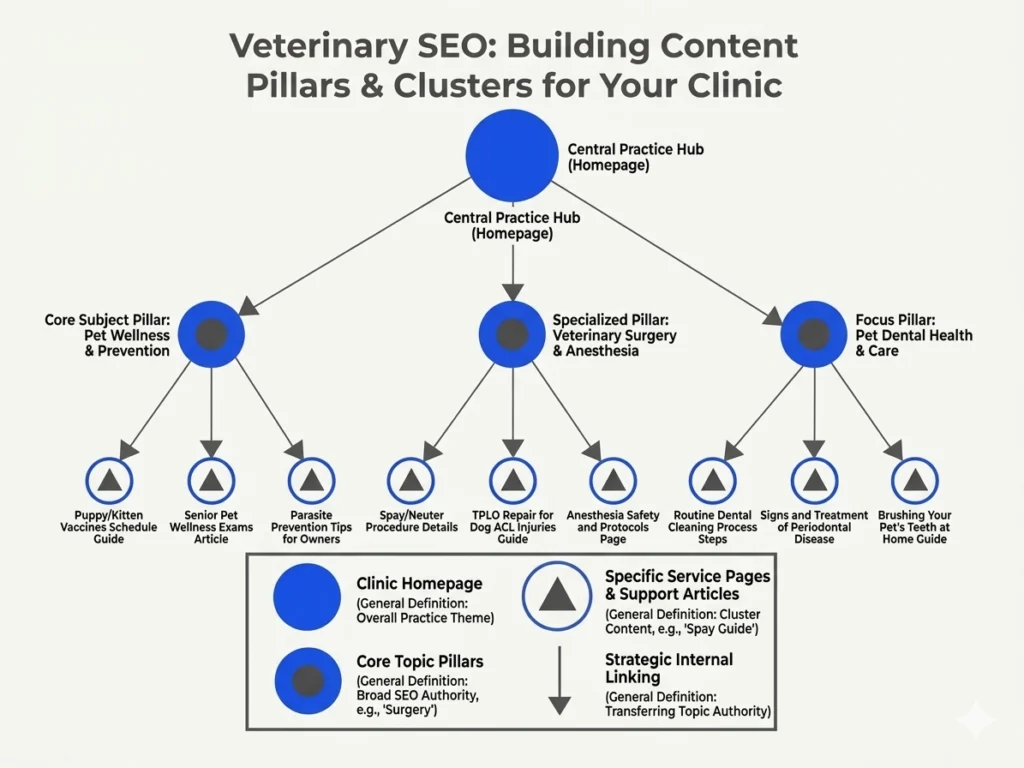
This internal linking strategy also supports client education through SEO. By connecting informative blog content to service pages, you’re helping existing clients discover preventative care options and reducing the volume of basic questions your staff handles by phone.
Most clinics use WordPress or Squarespace. Both have built-in SEO tools, so you don’t need to be a tech expert to get started. For wordpress, there are wide range of plugins for seo but we prefer Rank Math as it provides a lot of features in their free tier.
5.2 Optimizing Page Elements for Search Engines and Users
| On-Page Element | Optimization Best Practice | Why It Matters |
| Title Tags | Create unique, compelling titles for each page that include your primary keyword and clinic name. Keep within ~60 characters to avoid truncation in search results. | Title tags are the clickable headline in search results. They’re one of the strongest on-page ranking signals and determine whether someone clicks through to your site. |
| Meta Descriptions | Write concise summaries (150-160 characters) that encourage clicks. Think of this as your ad copy. Include relevant keywords and a clear call to action. | While not a direct ranking factor, meta descriptions significantly impact click-through rates. Higher CTR signals to Google that your result is valuable. |
| H1 Header Tag | Use one H1 per page containing your primary keyword. This should be your main page title and clearly describe what the page is about. | The H1 is the most important header tag. It tells both users and search engines the main topic of your page. Make it descriptive and keyword-rich. |
| H2 & H3 Headers | Use subheadings (H2, H3) to break up content and improve readability. Include secondary keywords naturally in these headers where relevant. | Headers create structure and make content scannable. They also give Google additional context about your page’s topics and subtopics. |
| URL Structure | Keep URLs short, descriptive, and keyword-rich. Use hyphens to separate words. Avoid numbers, dates, and unnecessary parameters. | Clean URLs are easier for users to remember and share. They also provide ranking signals about page content. |
| Image Optimization | Use descriptive filenames (e.g., golden-retriever-dental-cleaning.jpg not IMG_1234.jpg). Add alt-text that describes the image for accessibility and SEO. Compress images for fast loading. | Images can rank in Google Image Search and drive traffic. Alt-text helps visually impaired users and gives Google context about your images. |
| Content Quality | Create valuable, comprehensive content that genuinely helps pet owners. Write in a clear, accessible style. Answer questions thoroughly. Aim for 800+ words on service pages, 1,200+ on blog posts. | Content quality is paramount. Google’s algorithms are sophisticated enough to recognize thin, unhelpful content. Comprehensive content ranks better and serves your audience better. |
| Internal Links | Link to related service pages and relevant blog posts using descriptive anchor text. Help users navigate your site and discover more of your content. | Internal linking distributes ranking power across your site, helps Google discover all your pages, and keeps visitors engaged longer—reducing bounce rate. |
| Call-to-Action (CTA) | Include clear CTAs on every page: “Schedule an Appointment,” “Call Now,” “Download Our New Client Form.” Make your CTAs prominent and action-oriented. | The goal of SEO is not just rankings—it’s conversions. Clear CTAs guide visitors toward becoming clients. |
Don’t just have a generic Services page. Create separate pages for each major service, like Pet Dental Care, Spay & Neuter, Emergency Vet Services, Puppy Vaccinations, and Senior Pet Care. Each page should target its own keywords and give clear information about that service.
The Anatomy of a Perfect Veterinary Service Page:
Most clinics have a generic Services page listing everything in one place. That approach splits your ranking potential across dozens of keywords and gives Google nothing specific to work with. The fix is simple: one page per service.
Here’s what a high-performing veterinary service page includes, in order:
Above the fold
- H1 tag with the service name and location (e.g., “Dog Dental Cleaning in Austin, TX”)
- One clear sentence describing what the service is and who it’s for
- A prominent CTA — “Book an Appointment” or “Call Us Now” — visible without scrolling
The service section
- What the procedure involves, written for a pet owner not a vet school exam
- What to expect before, during, and after
- How long it takes and any recovery notes
- Pricing guidance if you’re comfortable publishing it (even a range builds trust)
Trust signals
- 2-3 client testimonials specific to this service, not generic clinic praise
- A photo of your team performing or preparing for this type of procedure
- Any relevant certifications or equipment that sets your clinic apart
Supporting content
- An FAQ block answering the 4-5 questions clients ask most about this service
- Internal links to related services (e.g., a dental page should link to your wellness exam page)
- A link to a relevant blog post (e.g., “Why Pet Dental Health Matters More Than You Think”)
Bottom CTA
- A second booking prompt at the end of the page for readers who scrolled through everything
The goal is that a pet owner lands on this page, gets every question answered, and books without needing to call first. The clinics that build pages like this consistently outrank competitors who have one bloated Services page.
6. Content Strategy: Becoming a Trusted Resource for Pet Owners
Building authority and trust requires consistent, high-quality content that genuinely helps pet owners. Your content strategy should position your clinic as the go-to resource for pet health information in your community.
6.1 The Importance of a Veterinary Blog
If you’re not sure wether you should write blogs or not, then know that a blog is a long-term investment. The benefits add up over time.
Blogging for veterinary clinics provides multiple strategic advantages.
- It attracts informational searchers who are potential future clients. Someone researching “What to do if your dog eats chocolate?” may not need your services today, but when their dog needs vaccinations next month, they’ll remember the helpful clinic that answered their emergency question.
- Blogging establishes your clinic as an expert and trusted resource in your community. Consistently publishing helpful, accurate content builds credibility that translates into client loyalty and referrals.
- Fresh content gives Google a reason to crawl your site regularly. Search engines favor websites that are regularly updated with new, valuable content.
- Blog posts generate internal linking opportunities to your service pages. Each informative article can naturally link to relevant services, guiding readers from education to action.
Start a clinic blog and answer common pet owner questions, like ‘What to do for a limping dog?’ or ‘When should I vaccinate my puppy?’ This builds trust and brings in people who may become clients later.
6.2 Evergreen Content Ideas for Your Blog and Service Pages
| Content Type | Topic Ideas | Strategic Value |
| Preventative Care Guides | “Comprehensive Puppy Vaccination Schedule & What to Expect”“The Ultimate Guide to Feline Flea & Tick Prevention”“Maintaining Your Senior Dog’s Joint Health”“Year-Round Parasite Prevention for Cats” | Evergreen content that remains relevant year after year. Attracts pet owners researching preventative care, positions your clinic as proactive rather than reactive, and naturally links to your preventative care services. |
| Common Pet Ailments & First Aid | “What to Do if Your Dog Eats Chocolate: A Vet’s Advice”“Recognizing the Signs of a Cat UTI”“First Aid for Minor Pet Injuries”“When to Worry About Pet Vomiting” | Captures high-intent traffic from pet owners in distress. These articles can convert immediately into emergency appointments or build trust for future needs. |
| Seasonal Pet Care Advice | “Summer Safety Tips for Your Dog in [City Name]”“Winterizing Your Outdoor Cat’s Shelter”“Holiday Pet Hazards to Avoid”“Spring Allergies in Pets” | Timely content that can be updated and republished annually. Shows your clinic is attentive to seasonal health concerns and local climate conditions. |
| Behind-the-Scenes & Meet the Team | “A Day in the Life of a Vet Tech”“Meet Dr. [Name]: Our Passion for Pet Care”“How We Handle Pet Emergencies”“What Happens During Your Pet’s Surgery” | Humanizes your clinic and builds emotional connections. Reduces anxiety about veterinary visits by demystifying processes. |
| Pet Life Stages | “Bringing Home Your New Puppy: A Complete Guide”“Caring for Your Senior Cat: What to Expect”“Preparing Your Pet for Their First Vet Visit”“Teenage Pets: Managing Adolescence” | Provides value at every stage of pet ownership, keeping your clinic top-of-mind throughout the pet’s entire life. |
When creating blog content, emphasize factual accuracy by sourcing information from reputable veterinary organizations or peer-reviewed studies.
Clearly state that blog content is for informational purposes and not a substitute for professional veterinary advice. This disclaimer protects your practice while still providing valuable information.
Consider developing an interactive “Vet SEO Readiness” self-assessment quiz for pet owners to assess their pet’s health needs (e.g., “Is Your Pet Overweight?”). Interactive content engages visitors, keeps them on your site longer, and can lead them naturally to relevant service pages.
For a complete, prioritized action plan that brings all these elements together, check out our Veterinary SEO Checklist: Everything Your Clinic Needs to Rank.
7. Technical SEO Basics for a Healthy Vet Website
Even without deep technical expertise, understanding the basics of technical SEO ensures your website is easily found and understood by search engines. Technical SEO is the foundation that supports all your other optimization efforts.
7.1 Website Speed and Mobile-Friendliness
Website speed matters for two reasons. First, people won’t wait for a slow site. Over half of mobile users leave if a page takes more than three seconds to load. 53% of mobile users abandon sites that take over 3 seconds to load. Second, Google ranks faster sites higher.
Test your site speed using Google PageSpeed Insights. This free tool analyzes your site and provides specific recommendations for improvement. Common fixes include compressing images, enabling browser caching, minimizing CSS and JavaScript, and using a content delivery network (CDN).
Mobile-friendliness is non-negotiable. Google uses mobile-first indexing, meaning it primarily uses the mobile version of your site for ranking and indexing. Most pet owners search for local vets on their phones, often in urgent situations. Your website must be fast and easy to navigate on mobile devices.
Optimizing for mobile requires a responsive design that adapts seamlessly to any screen size, readable fonts without zooming, easy-to-tap buttons and links with adequate spacing, and streamlined navigation that doesn’t overwhelm small screens.
Claim your site on Google Search Console. It’s free and acts like an engine light for your website. You’ll get an email if your site crashes or if Google can’t index your new pages.
SEO only works if you get the basics right. Each part supports your online presence. If you skip one, you’ll feel it.
7.2 Secure Connections and Site Structure
Check that your website uses HTTPS. Look for the padlock icon in your browser. Security matters for rankings, and a ‘Not Secure’ warning will scare off clients who want to book or share pet health info.

| Technical Aspect | Why It Matters | How to Implement |
| HTTPS (SSL Certificate) | Ensures secure communication between users and your site, visible as ‘https://’ and a padlock icon in the browser. Google confirmed HTTPS as a ranking factor, and it builds user trust, especially for sites handling sensitive health information. | Purchase an SSL certificate from your hosting provider (many include it free). Install it on your server. Update all internal links to use https://. Submit your site to Google Search Console as an https:// property. |
| XML Sitemaps | A file listing all important pages on your site, helping search engines discover your content efficiently. | Most website platforms generate sitemaps automatically. For WordPress, use a plugin like Yoast SEO or Rank Math. Submit your sitemap to Google Search Console at yoursite.com/sitemap.xml. |
| Crawlability & Indexability | Ensures search engine bots can access and add your pages to their index. Without this, your pages cannot rank. | Use Google Search Console to monitor crawl errors. Check your robots.txt file to ensure you’re not accidentally blocking important pages. Use the URL Inspection tool to verify that important pages are indexed. |
| Website Speed | Fast-loading sites provide better user experience and rank higher. Slow sites frustrate users and increase bounce rates. | Compress images before uploading. Use a caching plugin. Choose quality hosting. Minimize HTTP requests. Consider a CDN for serving images and static files. |
| Mobile Responsiveness | With mobile-first indexing, your mobile site is what Google primarily evaluates for rankings. | Use a responsive theme or design. Test on actual mobile devices. Use Google’s Mobile-Friendly Test tool. Ensure touch elements are adequately spaced. |
| Structured Data | Schema markup helps search engines understand your content and can enable rich results in search (like star ratings, business hours, etc.). | Implement local business schema, review schema, and FAQ schema where appropriate. Use Google’s Structured Data Testing Tool to validate. |
Regularly audit your website for technical issues. Use Google Search Console to check for broken links, crawl errors, and mobile usability problems. Address issues promptly as they can compound over time and significantly impact your rankings.
Technical SEO can seem like a lot, but the basics are doable. Make sure your site is secure with HTTPS, loads quickly on mobile, works on any device, can be crawled by search engines, and has a sitemap. Get these right, and you’ll have a strong foundation.
8. Online Reviews and Reputation Management
Your online reputation isn’t just important for SEO—it’s often the deciding factor in whether a pet owner chooses your clinic over a competitor. Reviews are critical social proof that influences both search rankings and consumer behavior.
8.1 The Power of Client Reviews
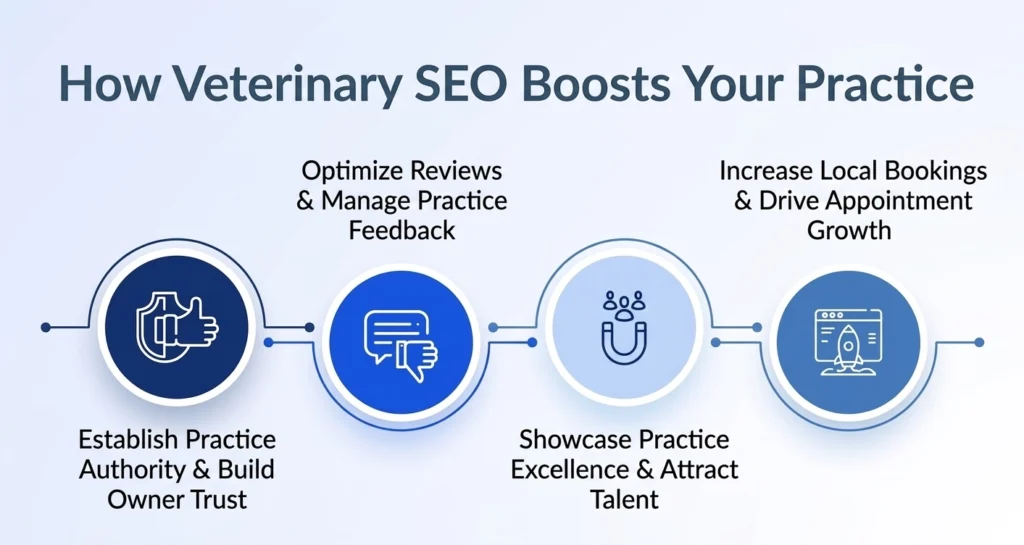
Google reviews are a major local ranking factor. Clinics with more reviews and higher average ratings tend to rank higher in local search results. But beyond SEO, reviews build trust. Pet owners read reviews to assess whether your clinic is competent, caring, and worth their trust with their beloved companions.
Ask clients for reviews regularly. The best time is right after a good visit, like a successful procedure or when a client thanks you. Make it part of your routine.
Make it easy for clients to leave reviews. Provide direct links to your Google Business Profile review section. You can create a short URL like g.page/yourclinic/review and include it in follow-up emails, on receipts, and in your clinic.
8.2 Responding to Reviews Professionally
Reply to every review, good or bad, as soon as you can. This shows you care about feedback and your clients’ experiences.
For positive reviews, express genuine gratitude. Thank the client by name, mention their pet, and reinforce what they appreciated. For example: “Thank you so much, Sarah! We’re so glad Max is feeling better after his dental cleaning. He was such a good patient, and we loved meeting him. We look forward to seeing you both at his next check-up!
For negative reviews, resist the urge to be defensive. Respond with empathy and a solution-focused approach. Acknowledge their concern, apologize for their experience, and offer to resolve the issue offline. For example: “We’re very sorry to hear about your experience, John. This doesn’t reflect the level of care we strive to provide. Please call our clinic manager directly at [number] so we can discuss this further and make things right.”
Never violate client confidentiality in review responses. Don’t discuss specific medical details. Keep responses general and professional.
Monitor online mentions of your clinic across social media and review sites. Set up Google Alerts for your clinic name. Respond promptly to feedback and address concerns before they escalate into lasting reputation damage.
Tools like BirdEye or Podium can streamline requesting and managing client reviews across multiple platforms. These platforms automate review requests and centralize your reputation management efforts.
Does SEO Actually Pay Off for Clinics?
Many practice owners ask if SEO is worth it compared to traditional marketing. The short answer: yes. When done right, the return from organic rankings is hard to beat.
Want to see the math for your specific clinic? Try the PAW Rank SEO ROI Calculator to forecast the potential revenue increase a solid search strategy can bring to your bottom line.
9. Measuring Your Veterinary SEO Success
If you don’t measure your SEO, you’re just guessing. Track the right numbers so you know what’s working and where to focus next.
9.1 Key Metrics to Track
Website Traffic:
Monitor total visits, unique visitors, and pageviews using Google Analytics 4. Look for upward trends over time. Pay particular attention to organic search traffic, visitors who found you through search engines rather than paid ads or social media.
Keyword Rankings:
Track where your clinic ranks for your target keywords. Are you on page one for “vet [your city]”? How about “emergency vet near me”? Tools like Google Search Console show which queries bring traffic to your site and your average position for each.
Google Business Profile Insights:
Your GBP provides valuable data: how many people found your listing through search vs. maps, how many viewed your photos, how many clicked for directions, phone calls, or website visits. These insights reveal how effectively your local SEO captures attention and drives action.
Appointment Requests and Calls:
The ultimate measure of SEO success is business growth. Track how many new clients mention finding you online. Use call tracking numbers on your website to measure phone conversions directly attributable to your site.
Conversion Rate:
Of all the people who visit your website, what percentage take a desired action—scheduling an appointment, calling your clinic, or downloading a new client form? A low conversion rate might indicate that while your SEO is driving traffic, your website isn’t persuasive enough.
9.2 Using Google Analytics and Google Search Console
Google Analytics:
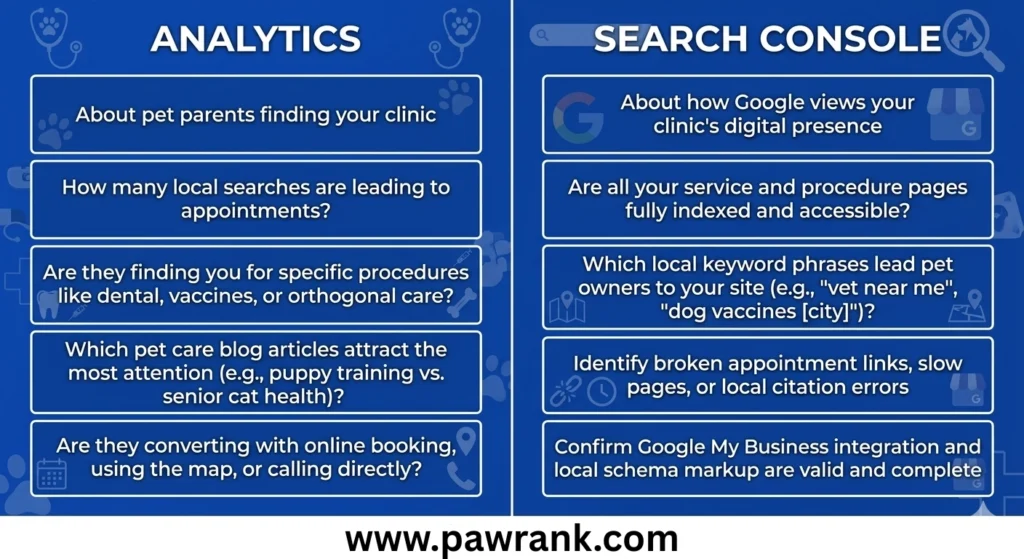
Google Analytics 4 is your primary tool for understanding website performance. It helps to see how visitors interact with your website and content. Set up goals to track key actions, such as appointment form submissions, phone clicks, and downloads. Monitor which pages attract the most traffic, how long visitors stay on your site, and which pages have high bounce rates (indicating visitors leave without engaging).
Google Search Console:
Google Search Console shows how Google sees your site. Monitor search performance to see which queries bring traffic, click-through rates for different keywords, and indexing status to ensure Google is properly crawling and indexing your pages. Use the Coverage report to identify and fix technical errors that might prevent pages from ranking.
Check your SEO numbers every month. Look for trends and adjust your plan as needed. SEO is ongoing. What works now might need tweaking later.
Funny story: When I started doing SEO, I used to check the Search Console every other moment. Then I learned that it can take days or weeks for Google to index your pages. So don’t repeat that mistake; checking the data once a week is a healthy practice.
10. Future Trends in Vet SEO (AI, Voice Search)
The SEO landscape continually evolves. Staying aware of emerging trends helps future-proof your strategy and maintain your competitive advantage.
10.1 AI in Search and Content
Google’s Search Generative Experience (SGE) and other AI-powered search tools are changing how results are displayed. AI-generated summaries may appear above traditional search results, synthesizing information from multiple sources. To remain visible in this environment, focus on being a cited source: create authoritative, well-researched content that AI tools will want to reference.
AI can help you draft content faster, but search engines are getting better at spotting content that lacks real expertise. Use AI as a tool, not a replacement for your own knowledge and voice.
Good SEO is Good AISEO/GEO. If your site is SEO-optimized, it also starts to get traffic from ChatGPT, Gemini, and any other LLMs. I am not making this claim out of nowhere; Google’s official John Muller said it in one of his conferences.
10.2 Voice Search Optimization
People increasingly use voice search—asking smart speakers and voice assistants questions like “Find a vet open now near me” or “What should I feed my puppy?” Voice searches tend to be longer and more conversational than typed searches.
Optimize for voice by structuring content to answer direct questions naturally. Create FAQ sections that address common questions in full sentences. Use natural, conversational language rather than stilted, keyword-stuffed prose.
Featured snippets—the boxes that appear at the top of Google results answering a specific question—are often used for voice search results. Structure your content to win these snippets by directly answering common questions in concise, clear formats.
Your Next Month Vet SEO Plan:
You now know the basics and next steps for veterinary SEO. But reading isn’t enough. Here’s how to turn this into real results for your clinic.
11.1 Getting Started: Your First 30 Days
Week 1: Foundation
- Claim and verify your Google Business Profile if you haven’t already
- Audit your NAP consistency across your website, GBP, and major directories.
- Install Google Analytics 4 and Google Search Console on your website.
- Conduct a basic keyword research session to identify your top 10 target keywords.
Week 2: Quick Wins
- Fully optimize your Google Business Profile (complete every section, add photos, create your first post)
- Update your website’s title tags and meta descriptions on your homepage and top 5 service pages.
- Fix any broken links or obvious technical errors identified in Google Search Console.
- Implement a review request process (create an email template to ask satisfied clients for reviews)
Week 3: Content Foundation
- Create or optimize 3 core service pages with proper on-page SEO
- Write and publish your first blog post addressing a common pet owner question.
- Set up proper internal linking between your service pages and blog content.
- Ensure your website is mobile-friendly and fast-loading
Week 4: Monitoring and Refinement
- Set up regular reporting in Google Analytics and Search Console.
- Monitor your first Google reviews (and respond to them!)
- Identify your next month’s content topics based on keyword research.
- Take a moment to recognize your progress. You’ve built a solid SEO foundation.
For a detailed, step-by-step checklist you can print and follow, see our complete Veterinary SEO Checklist: Everything Your Clinic Needs to Rank.
11.2 Long-Term SEO Success
SEO isn’t a one-and-done job. Long-term results come from steady effort.
- Consistent Content Creation: Publish at least one high-quality blog post monthly. More is better, but consistency matters more than volume.
- Regular GBP Maintenance: Update your Google Business Profile weekly with posts, photos, and accurate information.
- Continuous Technical Optimization: Quarterly technical audits to identify and fix issues before they impact rankings.
- Active Reputation Management: Ongoing review, solicitation, and professional responses to all feedback.
- Data-Driven Refinement: Monthly analysis of your metrics to identify what’s working and what needs adjustment.
- Staying Updated: SEO best practices evolve. Dedicate time quarterly to learning about algorithm updates and emerging trends.
Frequently Asked Questions (FAQs) about Veterinary SEO
How long does it take to see results from veterinary SEO?
SEO is inherently competitive. You are not only aiming to rank, but also to surpass clinics that may have invested in SEO for years. This factor primarily determines the timeline.
In low-competition markets, measurable progress typically appears within 3 to 6 months. In more competitive markets, significant results are more likely within 6 to 12 months. Quick wins, such as Google Business Profile optimization, may be visible within weeks. However, organic rankings require more time as Google must establish trust in your site’s authority compared to other clinics targeting the same terms.
This is why we begin every client engagement with a market analysis. It identifies your competitors, provides a realistic timeline, and recommends an appropriate budget for your market before any investment is made.
Can I do SEO myself, or do I need to hire an agency?
Many foundational SEO tasks, such as optimising your Google Business Profile, creating high-quality content, and requesting reviews, can absolutely be done in-house. However, technical SEO, advanced link building, and comprehensive strategies often benefit from professional expertise. Many successful clinics start with DIY basics and bring in specialists as their practice grows and SEO needs become more complex.
How much should I budget for veterinary SEO?
SEO budgets vary widely based on market competition and goals. DIY efforts cost mainly time (10-20 hours/month) and tools ($50-200/month). Professional SEO services for veterinary clinics typically range from $1,500 to $5,000 per month, depending on the scope. The ROI, however, often exceeds traditional advertising—one new client can justify a month’s SEO investment.
What’s more important: Google Ads or SEO?
Both serve different purposes. Google Ads delivers immediate visibility and can be turned on/off instantly, making it ideal for new clinics or promoting specific services. SEO builds sustainable, long-term visibility with lower cost-per-acquisition over time. The ideal strategy typically combines both: ads for immediate needs and competitive keywords, SEO for long-term, cost-effective growth.
How many reviews do I need to rank well locally?
There’s no magic number, but more is generally better. Focus on consistently earning reviews rather than hitting a specific target. A clinic with 50 recent reviews and a 4.8 average rating will typically outrank a competitor with 200 older reviews and a 4.0 rating. Review velocity (how frequently you get new reviews), recency, and average rating all matter.
Should I worry about competitors copying my SEO strategy?
Not really. Your unique value proposition, authentic expertise, client relationships, and consistent execution are impossible to copy. SEO tactics are publicly available knowledge—the competitive advantage comes from implementing them better and more consistently than competitors. Focus on serving your clients and community, not on what competitors are doing.
What if I’m in a competitive market with many established vets?
Competition makes SEO more challenging but not impossible. Focus on hyper-local optimization (neighborhood-specific keywords), niche services (exotic pets, holistic care, emergency services), and exceptional content that demonstrates genuine expertise. Smaller, newer clinics often outrank larger competitors by being more agile, authentic, and focused on specific market segments.
Conclusion: Your Path to SEO Success Starts Today
Veterinary work is about expertise, compassion, and helping animals. Your SEO should reflect those same values. Give real help to pet owners, build trust through clear information, and serve your community online and off.
You now have a clear plan for veterinary SEO. You know how pet owners search, what Google looks for, and how to match your online presence to your clinic’s mission. Most importantly, you have steps you can start using today to bring in more clients.
SEO isn’t about tricking Google. It’s about making it easier for pet owners to find you when they need help. It’s about showing up when someone searches for an emergency vet at midnight and answering questions that build trust before they call.
The clinics that do well online are consistent. They don’t try to do everything at once. Instead, they post on their Google Business Profile, write a blog, update a service page, or reply to reviews every week. Small, steady actions add up.
This guide is just the starting point. Update your Google Business Profile today. Write one helpful blog post this week. Ask your next happy client for a review. Each small step gets you closer to building the practice you want.
The pet owners in your community are searching. Make sure they find you.
Want to know exactly how your clinic stacks up online?
You’ve probably read plenty about SEO. Putting it into practice while running a clinic is a different story. Hope isn’t a strategy, especially when your time is limited.
You don’t need a perfect website to rank. You just need to be a step ahead of the clinic that’s ranking above you.
We don’t guess. We diagnose what’s working and what’s not.
If you’re tired of seeing another clinic at the top of local search, let’s look at what they’re actually doing.
Book Your Free Competitor Analysis & Strategy Session →Here’s what to expect:
A focused 30-minute session to review your site and your top competitor.
- We’ll screen-share real data — your site and your competitor’s side by side
- You’ll see exactly where they’re ahead: keywords, backlinks, and technical setup
- We’ll lay out clear steps to close the gap and bring in more clients
No sales pitch. No obligation. Just straightforward SEO data and honest advice from people who know the veterinary field.
Let’s see if working together makes sense for your clinic.